10 min read
 19.08.2026
How Do SBA Loans Work and Who Lends the Money
By Grants.com Editorial Team. Reviewed by Elise Perez, Grant Writer and Editorial Reviewer

SBA loans work through a guarantee, not a government cheque. The SBA does not lend money to most businesses. It promises a partner lender that it will cover part of the loss if the loan goes bad, and that promise is what makes a bank willing to fund a business it would otherwise turn down. According to sba.gov (checked August 17, 2026), you apply directly through a lender and work with that lender, not with the SBA.
That single fact explains most of what confuses people about the process.
SBA loans work like this: a bank or nonprofit lender makes the loan, the SBA guarantees part of it, and the borrower repays the lender. The SBA sets programme rules and eligibility, but the lender makes the credit decision and sets the documents you file, per sba.gov (checked August 17, 2026).
Want to know which programme fits before you call anyone? Take the free Funding Eligibility Assessment.
Grants.com is a private funding-discovery and assistance platform. It is not a government agency and does not issue or approve grants unless explicitly stated for a specific programme. Grants.com does not guarantee eligibility, approval, funding, award amounts, application outcomes, loan approval, or tax-credit acceptance. Final decisions are made by independent funders, agencies, lenders, or tax authorities. Information provided through Grants.com is for general informational and educational purposes and may not reflect the most recent programme rules. Users should verify eligibility, deadlines, requirements, and application procedures with the official funding organisation.
What does the SBA actually do?
It guarantees, it does not lend. The 7(a) programme, which sba.gov calls its primary business loan programme, “provides a loan guarantee to lenders that allow them to provide financial help for small businesses with special requirements.” The money comes from the lender. The risk is shared with the government.
Read that from the lender’s side and the whole system makes sense. A bank looks at a four-year-old business with thin collateral and says no. The same bank, with part of the loan guaranteed, can say yes. The guarantee doesn’t make you a better borrower. It changes what the lender stands to lose.
This is also why the SBA cannot tell you whether you will be approved. It isn’t the one deciding.
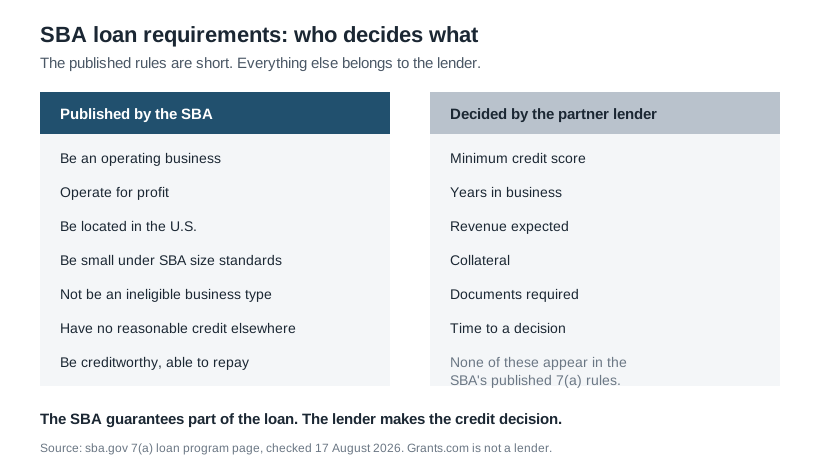
How does the SBA loan process work, step by step?
Four steps, and the first one surprises people.
You find the lender first. Not the paperwork. Per sba.gov, the contents of a loan application vary with the size of the loan and the lender’s processing method, and your lender tells you which documents you’ll need. So assembling a document pile before you have a lender is work you may redo. The SBA runs a free Lender Match tool, and SBA District Offices give free help in person, online, or by phone.
The lender tells you what it needs. Expect financial statements and a clear explanation of how you’ll use the funds, in the categories the programme publishes. Beyond that, lists differ, and any site giving you a universal checklist is guessing.
The lender underwrites and decides. This is the real gate. The published eligibility rules are the floor; the lender’s own credit standards sit on top, and two lenders can answer the same file differently. The full published list is on our SBA loan requirements page.
You repay the lender. Most 7(a) term loans are repaid with monthly payments of principal and interest from the cash flow of the business, per sba.gov. Payments stay level on fixed-rate loans. On variable-rate loans the lender may require a different payment when the rate changes.
Nobody legitimate charges you a fee to be introduced to an SBA lender. Lender Match and District Office help are free.
The main programmes, and how they differ
Two cover most situations, and they differ by size and by who does the lending.
7(a) runs up to $5 million through banks and other partner lenders. Its published uses include real estate, short and long term working capital, refinancing business debt, machinery and equipment, furniture and fixtures, and changes of ownership.
Microloans run up to $50,000 through nonprofit community-based intermediary lenders, with an average of about $13,000 and a maximum term of seven years. Those intermediaries make all credit decisions and set all terms. The detail is on our SBA microloans page.
The SBA also runs a 504 programme aimed at fixed assets like buildings and heavy equipment, through Certified Development Companies. Different structure, different lender, and worth asking about if property is what you’re buying.
Who actually ends up in this lane?
Mostly people who arrived looking for something else. Among 118 for-profit respondents to the Grants.com Funding Eligibility Assessment between 22 May and 16 July 2026, 73.7% were pre-revenue or earning under $5,000 per month, and 51.7% had operated for one year or less. (Source: Grants.com Funding Eligibility Assessment, 118 for-profit respondents, 22 May – 16 July 2026.)
Across all 672 submissions in the same period, 44.5% were seeking under $50,000. (Source: Grants.com Funding Eligibility Assessment, 672 submissions, 22 May – 16 July 2026.)
Read those together and a pattern appears. The typical person searching how SBA loans work is small, young, and asking for a modest amount. That profile rarely wins competitive grant funding, which is why so many searches that start with the word “grant” end in the lending lane. If a grant is genuinely what you’re after, our page on SBA grants gives the sourced answer about what exists.
What SBA loans are not
They are not grants, and the difference is not a technicality. A loan repays. A grant does not repay but carries eligibility rules, allowable-cost limits, and reporting duties.
An SBA loan is also not approved by the SBA, not free of a credit check, and not instant. Anyone describing an SBA “loan” you never repay, or promising approval before a lender has seen your file, is describing something that does not exist in the programme rules.
And some businesses will not qualify. A business that isn’t operating yet, a nonprofit, an ineligible business type under federal regulation, or a business whose cash flow can’t carry the payments will hear no. Knowing that early is cheaper than finding out after a decline.
So the short version of how SBA loans work: the lender lends, the SBA guarantees, you repay the lender, and the answer you get depends on which lender you ask. The fastest way to see whether this lane fits your numbers at all is the free Funding Eligibility Assessment. It approves nothing. It just stops you applying to the wrong door.
Frequently asked questions
Does the SBA give you the money directly?
No. For 7(a) loans you work directly with a partner lender, not with the SBA, per sba.gov. The SBA guarantees a portion of the loan so the lender is willing to make it. Microloans work the same way through nonprofit intermediary lenders.
How does the SBA guarantee work?
The SBA promises the lender it will cover part of the loss if the borrower defaults. That reduces the lender’s exposure and is the reason a lender may approve a business it would otherwise decline. The guarantee protects the lender, not the borrower, and the borrower still owes the full loan.
How long does the SBA loan process take?
The SBA publishes no universal timeline. Application contents and processing vary with the loan size and the lender’s method, so the accurate answer comes from the lender you apply with. Ask for their current timeline before you file.
Do you need collateral for an SBA loan?
The SBA’s published 7(a) eligibility list does not set a collateral rule; it requires that a business be creditworthy and show a reasonable ability to repay. Collateral requirements come from the lender, so they vary. Ask the lender directly rather than assuming.
Can you get an SBA loan with no revenue yet?
The programme requires an operating business, so a pre-launch idea does not qualify. A newly operating business may be eligible, and the lender weighs credit history and repayment ability. Standards differ by lender, and some will say no where others look further.
What is the difference between a 7(a) loan and a microloan?
Size and channel. The 7(a) programme reaches up to $5 million through banks and other partner lenders. Microloans reach up to $50,000 through nonprofit intermediaries, averaging about $13,000, per sba.gov. Both are loans and both repay.