


 10 min read
 12.08.2026
Grants for Women: What’s Real and Who Qualifies
By Grants.com Editorial Team. Reviewed by Elise Perez, Grant Writer and Editorial Reviewer
Grants for women are real, but they are smaller and rarer than the ads suggest. If you are searching this to fund a business, the honest answer is that no federal grant exists to start or run an ordinary for-profit company. The U.S. Small Business Administration says so on its own SBA grants page. A handful of private grants for women do exist, and they are small and heavily contested. For most women-owned businesses, the money that actually moves is SBA-backed lending, free counseling, or federal contracting, not a grant.
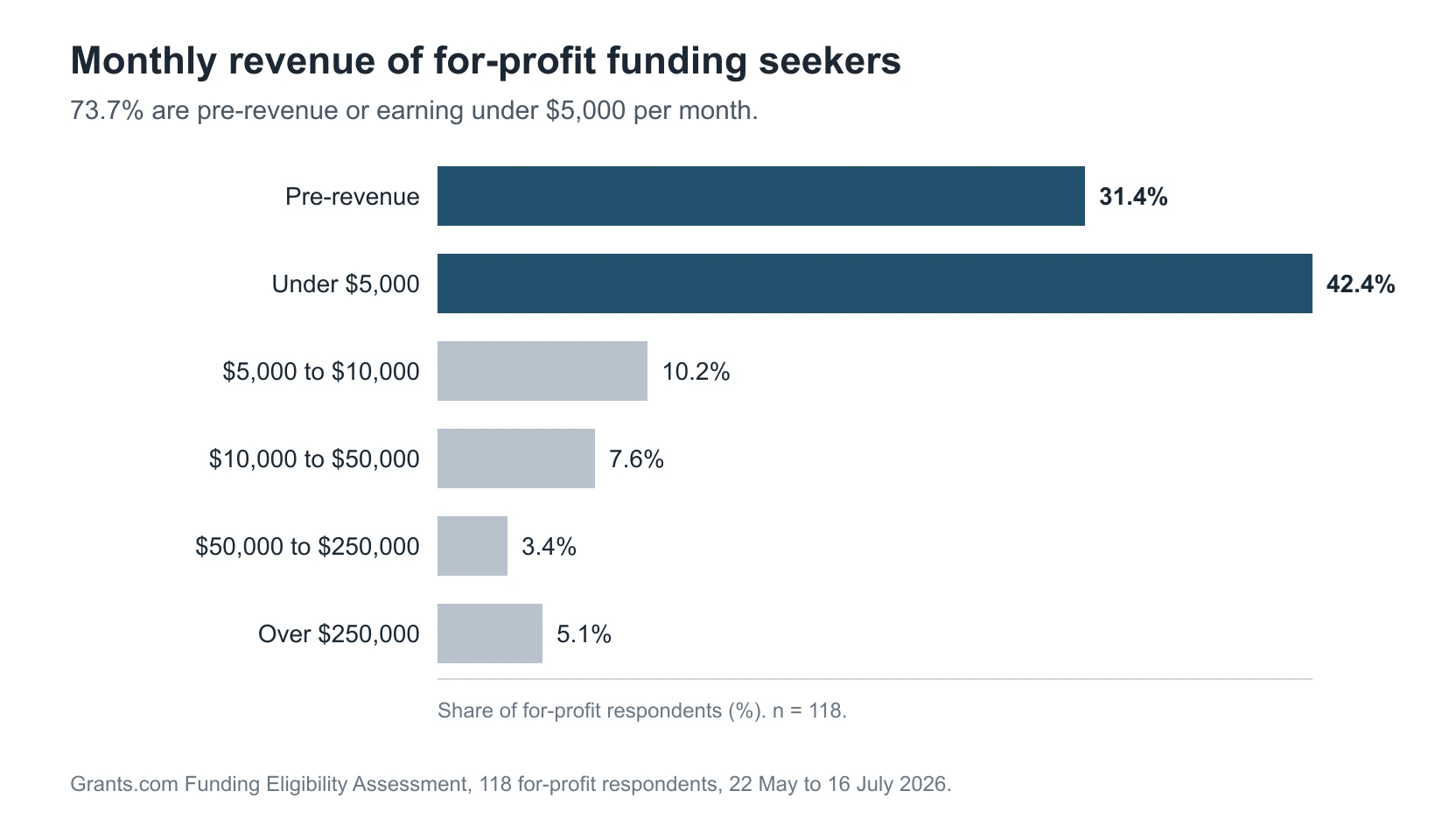
Across 118 for-profit respondents to the Grants.com Funding Eligibility Assessment between 22 May and 16 July 2026, 73.7% were pre-revenue or earning under $5,000 per month, and 51.7% had operated for one year or less. Most for-profit funding seekers are not grant candidates. They fit lending or counseling instead. (Source: Grants.com Funding Eligibility Assessment, 118 for-profit respondents, 22 May to 16 July 2026.)
Want to see which lane fits your business before you spend weeks applying? Take the free Funding Eligibility Assessment.
Grants.com is a private funding-discovery and assistance platform. It is not a government agency and does not issue or approve grants unless explicitly stated for a specific program. Grants.com does not guarantee eligibility, approval, funding, award amounts, application outcomes, loan approval, or tax-credit acceptance. Final decisions are made by independent funders, agencies, lenders, or tax authorities.
Are there really grants for women?
Yes, but fewer than the search results imply, and almost none are federal cash for a for-profit business. The private grants that exist are usually small, often awarded monthly, and open to large applicant pools. Federal money aimed at women tends to arrive as contracting access or free counseling, not as a check to spend on general business costs.
That gap matters because the word people type and the thing they need rarely match. Anonymized search language on the platform shows people often mean “funding” when they type “grant.” For a woman raising money for a for-profit business, the accurate framing is non-repayable funding versus lending, and the non-repayable pool is thin.
Personal grants are a separate question. Federal grants go to organisations and defined project purposes, not to individuals for rent, bills, or personal costs. If that is what you need, the honest path is official screening tools and local assistance, not a business grant.
Does the government give grants to women to start a business?
No. The SBA does not provide grants to start or grow an ordinary business, and it states this directly. SBA grants go to nonprofits, resource partners, and educational organisations that support entrepreneurs, not to individual for-profit firms. Applying for federal grants is also free; the full list lives at grants.gov, and no federal agency charges a fee to apply.
What the government does offer women running businesses falls into three areas: contracting access through the Women-Owned Small Business program, free counseling through Women’s Business Centers, and SBA-backed loans made by partner lenders. None of these is a grant, and each has its own gate.
What women-owned businesses actually qualify for
Most early-stage for-profit businesses qualify for lending or counseling long before they qualify for a grant. Grants usually attach to a specific project, a defined mission, or an entity type, and they carry eligibility rules, allowable-cost limits, and reporting duties. A pre-revenue sole proprietor looking for cash to cover general operating costs is rarely a grant candidate, and saying so plainly is more useful than a list of programs the business cannot win.
This is where the platform’s own data is blunt. When 73.7% of for-profit funding seekers are pre-revenue or under $5,000 in monthly revenue, and more than half have operated a year or less, the realistic answer for the majority is a readiness step and a lending or counseling lane, not a grant application. You may be eligible for a given program, but the funder makes the award decision, and some readers will not qualify. You can search current grant listings to check what is open, then screen honestly against the rules before you invest time.

The real funding lanes for women-owned businesses
Three routes do most of the real work for women-owned for-profit businesses, and none of them is a grant. Here is how the lanes compare on the things that decide whether you fit.
| Private grants for women | SBA microloan | SBA 7(a) loan | SBA 504 loan | |
|---|---|---|---|---|
| Published maximum | $10,000 monthly awards, plus a $50,000 year-end award (WomensNet) | $50,000, average about $13,000 | $5 million | $5.5 million |
| What it covers | Only what the award’s own rules allow | Working capital, inventory, supplies, furniture, fixtures, machinery, equipment | Real estate, working capital, refinancing, equipment, changes of ownership | Buildings, land, and machinery with at least 10 years of useful life left |
| What it will not cover | Costs outside the allowable-cost rules | Paying existing debts or buying real estate | See the SBA eligibility rules for ineligible business types | Working capital or inventory |
| Does it repay? | No, but it carries reporting duties | Yes | Yes | Yes |
| Who decides | The funder | The SBA-approved intermediary lender | The lender, not the SBA | A Certified Development Company with a senior lender |
The first is SBA-backed lending. The SBA does not lend to most businesses directly; it sets terms for loans made by partner lenders, including 7(a) loans and microloans. These are loans, so they repay, and the lender decides. Grants.com does not set or advertise rates, payments, or terms.
The second is federal contracting. The Women-Owned Small Business program sets aside certain federal contracts for businesses that are at least 51% owned and controlled by women who are U.S. citizens, and where women manage day-to-day operations. The government-wide goal for women-owned small businesses is 5% of federal contracting dollars. The economically disadvantaged subset, EDWOSB, adds tests on personal net worth, adjusted gross income, and personal assets. This is access to contracts, not cash handed over.
The third is counseling. Women’s Business Centers are a national network of entrepreneurship centers across the United States and its territories, and they offer free to low-cost counseling and training for women who want to start, grow, and expand a small business. For a business that is not yet fundable, this is often the highest-value first stop.

How private grants for women actually work
Private grants for women are legitimate, and the largest of them run on a published schedule instead of a single deadline. WomensNet awards three $10,000 Amber Grants every month, and three of its 36 annual monthly winners receive an additional $50,000 Year-End Amber Grant, for $510,000 across a year from one application form. The first Amber Grant was awarded in 1998 in memory of Amber Wigdahl, who died at 19. (WomensNet grant pages, checked 17 August 2026.)
One of those three monthly streams points straight at the segment our own data describes. WomensNet defines a startup as a business in the idea phase or with sales under $10,000, and runs a separate $10,000 Startup Grant for it each month. Read against the assessment, where 73.7% of for-profit respondents are pre-revenue or under $5,000 in monthly revenue, that’s the rare grant lane built for the majority profile rather than one that screens it out. It doesn’t change who decides. The funder still makes the award.
Programs designed around women-focused projects, like AAUW community action grants, judge on fit and impact, not just need.
Application fees are where judgment matters. Some private grants charge a small, disclosed review fee, and one application can enter you into several award pools at once. A disclosed review fee is different from anyone asking you to pay to release money you have supposedly already won. The second is always a scam, and the next section covers how to tell them apart.

How do you spot a grant scam that targets women?
Applying for a federal grant is free, and no legitimate program asks you to pay to receive money you have been awarded. Both facts come straight from the agencies. Grants.gov states plainly that the government does not charge a fee to apply, and the FTC warns that no government agency will ask you to pay by gift card, wire transfer, or cryptocurrency to get a grant.
Scammers know these programs draw hopeful women entrepreneurs, so they impersonate real grants with fake winner emails, fees to “release” funds, and requests for bank details. The verification steps are simple: confirm the program on the funder’s own site or at the grants.gov fraud page, never pay to collect an award, and report suspected fraud through the FTC grant-scam guidance. For a running list of current patterns, the grant scam safety center tracks what to watch for.
Frequently asked questions
Are there really grants for women?
Yes, but they are limited. Most are small private awards, often monthly, with large applicant pools. There is no federal grant to start or run an ordinary for-profit business; the SBA states this on its grants page. Federal support for women in business arrives mainly as contracting access and free counseling.
Does the government give grants to women to start a business?
No. The SBA does not give grants to start or grow a business, and applying for federal grants is free through grants.gov. The government’s women-focused help is the Women-Owned Small Business contracting program and Women’s Business Centers, not startup cash.
How do you apply for a women’s small business grant?
Find a program on the funder’s own site, confirm you meet every eligibility rule, and submit the exact documents it lists by its stated deadline. You may be eligible, but the funder makes the award decision. Never pay to submit or to release an awarded federal grant.
Do you have to pay to apply for grants for women?
Federal grant applications are always free. Some private grants charge a small, disclosed review fee, which is different from a scam that asks you to pay to release money you supposedly won. No legitimate program requires payment to hand over an award.
What counts as a women-owned business for grant eligibility?
It depends on the program, but the federal Women-Owned Small Business program requires a business that is at least 51% owned and controlled by women who are U.S. citizens. The economically disadvantaged subset adds net-worth and income tests. Private grants set their own ownership rules.
Are grants for women owned businesses free money?
No. Non-repayable funding still carries eligibility rules, allowable-cost limits, and reporting duties, and loans repay. Nothing here is risk-free. Treat any offer of guaranteed or instant “free money” as a warning sign, not an opportunity.
What to do next
The most useful move for most women searching grants for women is to learn which lane fits before spending weeks on applications that were never open to them. If your business is early or pre-revenue, counseling or lending will usually move faster than a grant. If a specific grant genuinely fits your project and entity, apply carefully and verify every program first. To see where your business stands across grants, lending, and counseling, take the free Funding Eligibility Assessment.
Information provided through Grants.com is for general informational and educational purposes and may not reflect the most recent program rules. Users should verify eligibility, deadlines, requirements, and application procedures with the official funding organisation. Content and automated recommendations do not constitute legal, tax, accounting, financial, or investment advice. Users should consult an appropriately qualified professional regarding their specific circumstances. Grants.com may connect users with independent consultants, lenders, tax professionals, or other service providers and may receive compensation from certain partners. Partner relationships do not guarantee eligibility, approval, or funding.
Recent Posts





How to Maximize Grant Funding for Educational Programs in 2026: Proven Strategies for Winning More Grants


Essential Steps for Nonprofits Seeking International Grants in 2026: Expert Guide to Global Funding Success


Share This Post


