8 min read
 04.09.2026
Grants for College: What’s Real and How to Apply
By Grants.com Editorial Team. Reviewed by Elise Perez, Grant Writer and Editorial Reviewer

Grants for college are financial aid you don’t repay in most cases. The federal government awards them through programs like the Pell Grant, which pays up to $7,395 for the 2026-27 award year, per studentaid.gov (checked August 29, 2026). States, colleges, and private organizations award them too. One form starts almost all of it: the FAFSA, and filing it costs nothing.
Two facts protect you before you read anything else. Applying for federal student aid is free through the FAFSA form at studentaid.gov, and no legitimate program charges a fee to release a student grant. An offer of guaranteed grant money for a payment is the pattern our scam safety center exists to catch.
College grants are need-based financial aid that doesn’t have to be repaid except in limited cases. The main federal programs are the Pell Grant, up to $7,395 for 2026-27, the FSEOG at $100 to $4,000 per year, and the TEACH Grant. Eligibility for each starts with the FAFSA form, per studentaid.gov (checked August 29, 2026).
Searching for business funding and landed here instead? The free Funding Eligibility Assessment takes your actual numbers and shows which funding lane fits.
Grants.com is a private funding-discovery and assistance platform. It is not a government agency and does not issue or approve grants unless explicitly stated for a specific programme. Grants.com does not guarantee eligibility, approval, funding, award amounts, application outcomes, loan approval, or tax-credit acceptance. Final decisions are made by independent funders, agencies, lenders, or tax authorities. Information provided through Grants.com is for general informational and educational purposes and may not reflect the most recent programme rules. Users should verify eligibility, deadlines, requirements, and application procedures with the official funding organisation.
What counts as a grant for college?
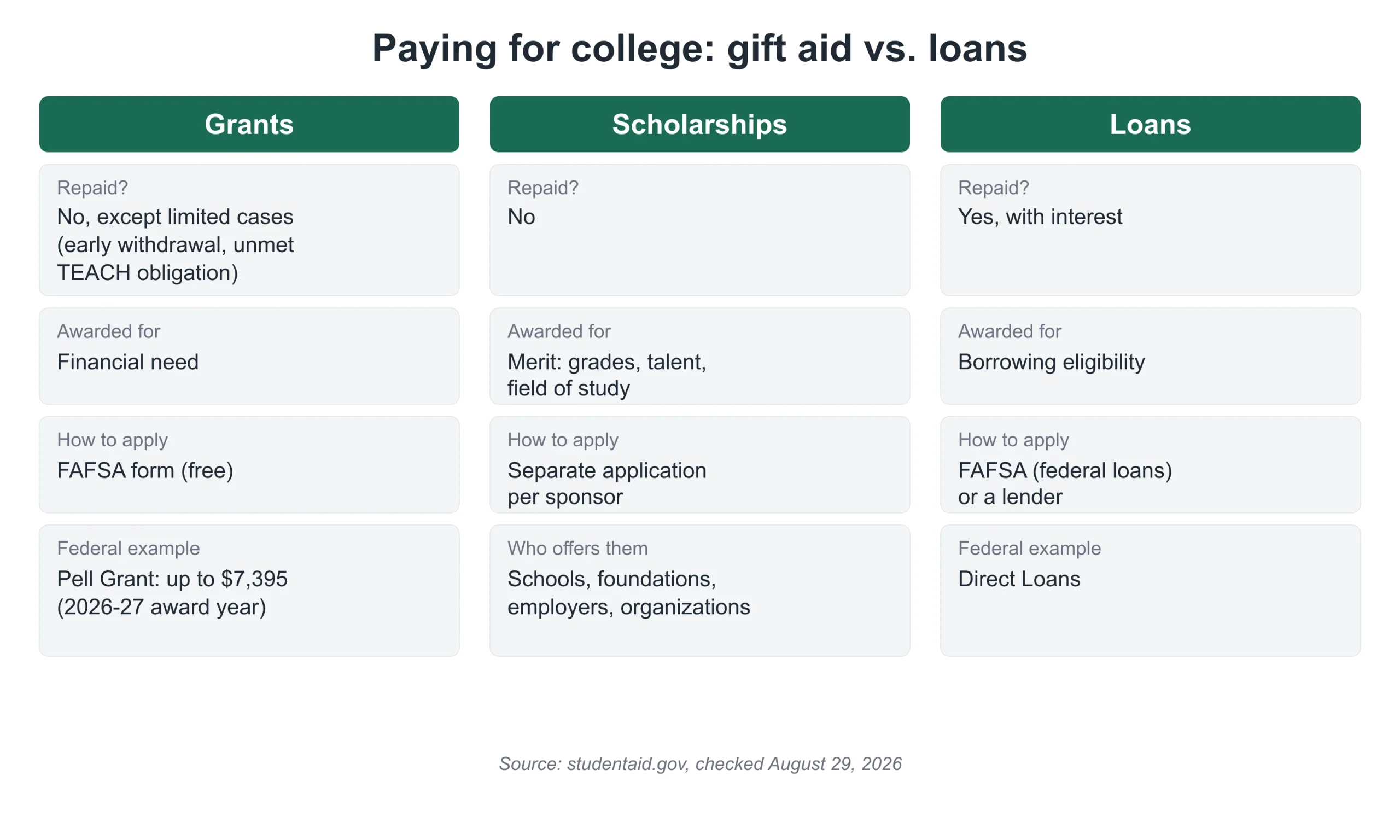
A grant is gift aid, money for school that the funder doesn’t expect back. Loans repay, with interest. Scholarships sit next to grants in the gift-aid bucket, but they’re usually awarded for merit, grades, athletics, or talent, while grants usually follow financial need.
The “usually” matters. A grant can convert into a debt if you withdraw early, drop below the enrollment level your award required, or fail the TEACH Grant’s teaching obligation. Studentaid.gov states that a Pell Grant “does not have to be repaid, except under certain circumstances” (checked August 29, 2026). Read the conditions before you count the money.
How much is the Pell Grant for 2026-27?
The maximum Federal Pell Grant is $7,395 for the 2026-27 award year, which runs July 1, 2026 to June 30, 2027, per the Pell Grant page at studentaid.gov (checked August 29, 2026). Your actual amount depends on your Student Aid Index from the FAFSA, your school’s cost of attendance, full-time or part-time status, and how much of your lifetime eligibility remains.
Pell is the one federal grant that doesn’t run out at the school level. If you’re eligible, you receive the full amount you qualify for, because the Department of Education funds every participating school for all of its eligible students. The limit is personal instead. You get 12 full-time terms, roughly six years.
Award amounts change yearly, and so can yours. A family income change moves your Student Aid Index, and the grant moves with it. Refile the FAFSA every year and read your FAFSA Submission Summary rather than assuming last year’s number.
Two smaller doors are worth knowing. Under year-round Pell, an eligible student can receive up to 150 percent of a scheduled award in one year by attending an additional term. And a student whose parent died on active duty or as a public safety officer may be eligible for the maximum award.
FSEOG: the federal grant that runs out
The Federal Supplemental Educational Opportunity Grant pays $100 to $4,000 per year to undergraduates with exceptional financial need, per the FSEOG page at studentaid.gov (checked August 29, 2026).
It works differently from Pell. Each participating school receives a fixed pool of FSEOG money each year, the financial aid office awards it to the students with the most need, and when the pool is gone, it’s gone for the year. Not every school participates. The school also sets its own deadline for these campus-based funds. File early and ask the financial aid office directly.
What’s the catch with the TEACH Grant?
The TEACH Grant pays up to $4,000 per year, but the fine print carries two numbers most guides skip. Awards first disbursed before October 1, 2026 are cut 5.7% by the sequester law, so the real maximum is $3,772, per the TEACH Grant page at studentaid.gov (checked August 29, 2026).
The second number is four. You agree to teach full-time for four years in a high-need field at a school serving low-income students, within eight years of leaving your program. Fall short and every TEACH Grant you received converts to a Direct Unsubsidized Loan, with interest charged from the date of each disbursement. There’s an academic gate too: generally a 3.25 GPA or a score above the 75th percentile on a college admissions test.
It’s a real grant for students committed to teaching. For everyone else it’s a loan with extra steps.
State, college, and private grants
States run their own grant programs, and most read your FAFSA data to award them. Some require a separate state application on top. Deadlines are the trap here. State deadlines often land months before the federal one, and studentaid.gov notes that missing a state deadline doesn’t affect your federal eligibility, so file the FAFSA even if your state’s date has passed (checked August 29, 2026).
Colleges award grants from their own funds. The financial aid office at each school on your list is the primary source for what exists there, and its net-price calculator shows what a school costs after gift aid.
Private grants come from foundations, employers, and community organizations, each with its own application. Verified opportunities are searchable in the Grants Database. Never pay for a list of grants and never pay anyone who promises an award. The search order that actually works, from FAFSA down to the private layer, is mapped on our find college grants page.
How do you apply for grants for college?
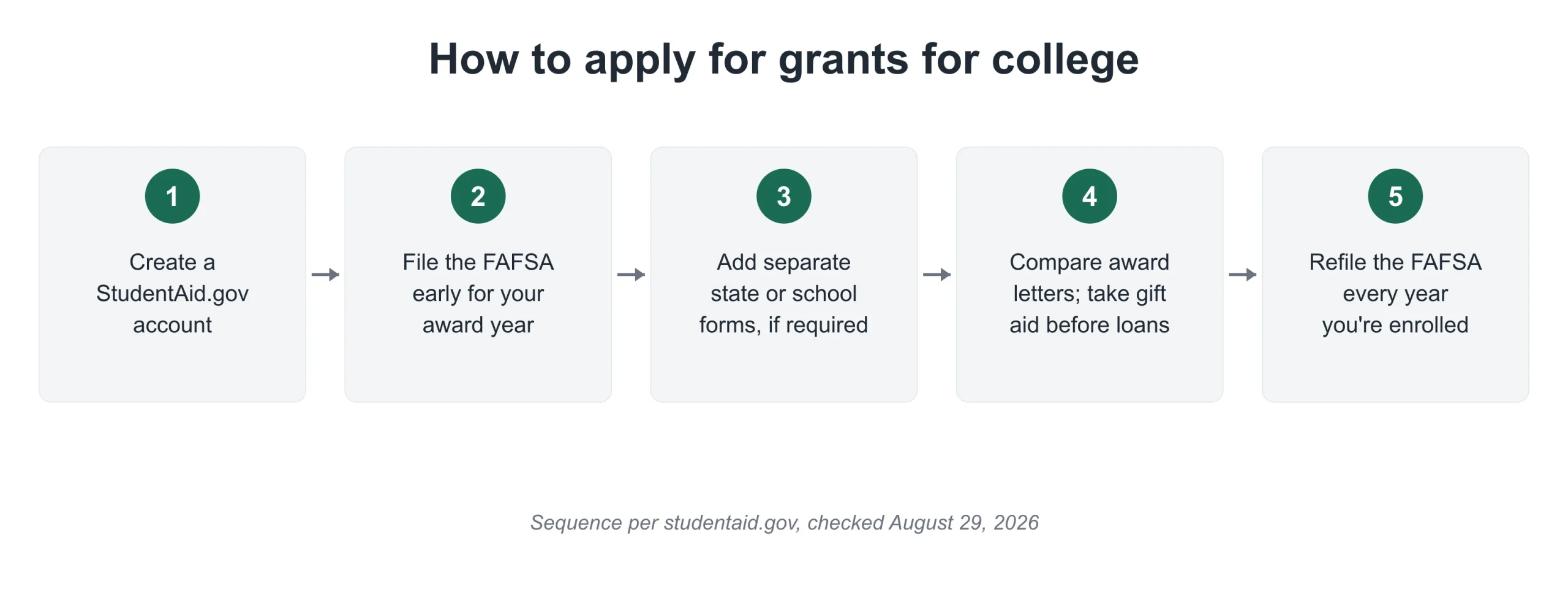
The sequence is short and the order matters.
- Create a StudentAid.gov account for yourself and, if you’re a dependent student, a parent.
- File the FAFSA form as early as you can for your award year. Campus-based money like FSEOG follows the early filers.
- Check whether your state or school needs a separate application, and its deadline.
- Compare award letters when they arrive. Take grants and scholarships before touching loans.
- Refile the FAFSA every year you’re enrolled. Eligibility doesn’t roll over.
Two questions are worth asking your financial aid office along the way. First, whether every class you registered for counts toward your degree program, since aid may not cover a course outside it. Second, whether a drop in family income since your FAFSA base year qualifies for a special circumstance review. Both conversations are free and both can change your award.
Do you have to pay back grants for college?
Generally no. The exceptions, per studentaid.gov: withdrawing early, an enrollment change that lowers your eligibility after funds were paid, and an unmet TEACH service obligation. A grant also carries standing obligations while you hold it, including enrollment, satisfactory academic progress, and the annual FAFSA refile.
One honest note for a different reader. If the funding you’re actually looking for is for a business rather than a degree, student aid rules won’t help you, and the published SBA loan requirements are the better starting point.
That’s the full picture on grants for college: real programs, a free application, exact dollar limits, and a handful of conditions worth reading before you rely on the money. Start with the FAFSA, ask your financial aid office the two questions above, and if you’re weighing funding paths, the free Funding Eligibility Assessment is the two-minute first step.
FAQ
What are grants for college?
Grants are financial aid for school that you don’t repay in most cases. They come from the federal government, state governments, colleges, and private organizations, and most are awarded based on financial need rather than merit.
How do I get grants for college?
File the FAFSA form at studentaid.gov. It’s free and it determines your eligibility for federal grants, most state grants, and most college grants in one submission. Some states and schools add a separate application, so check each deadline.
What is a Pell Grant?
The Pell Grant is the largest federal grant program, paying up to $7,395 for the 2026-27 award year, per studentaid.gov (checked August 29, 2026). It goes to undergraduates with exceptional financial need, and the amount depends on your Student Aid Index and cost of attendance.
Can I get a grant for an online program?
Often yes, if the school participates in federal student aid programs and the program leads to your degree. Eligibility is the school’s and the Department of Education’s determination, so confirm with the school’s financial aid office before enrolling.
Do grants cover summer classes?
They can. Under year-round Pell, an eligible student may receive up to 150 percent of a scheduled award in one award year by attending an additional term, per studentaid.gov (checked August 29, 2026). Ask your financial aid office how your school handles it.
Does missing a state deadline end my federal aid?
No. Studentaid.gov states that missing a state deadline doesn’t affect eligibility for federal student aid (checked August 29, 2026). You lose the state money, not the federal money, so file the FAFSA regardless.