8 min read
 04.09.2026
Cal Grant: Who Qualifies, Award Amounts, and Deadlines
By Grants.com Editorial Team. Reviewed by Elise Perez, Grant Writer and Editorial Reviewer

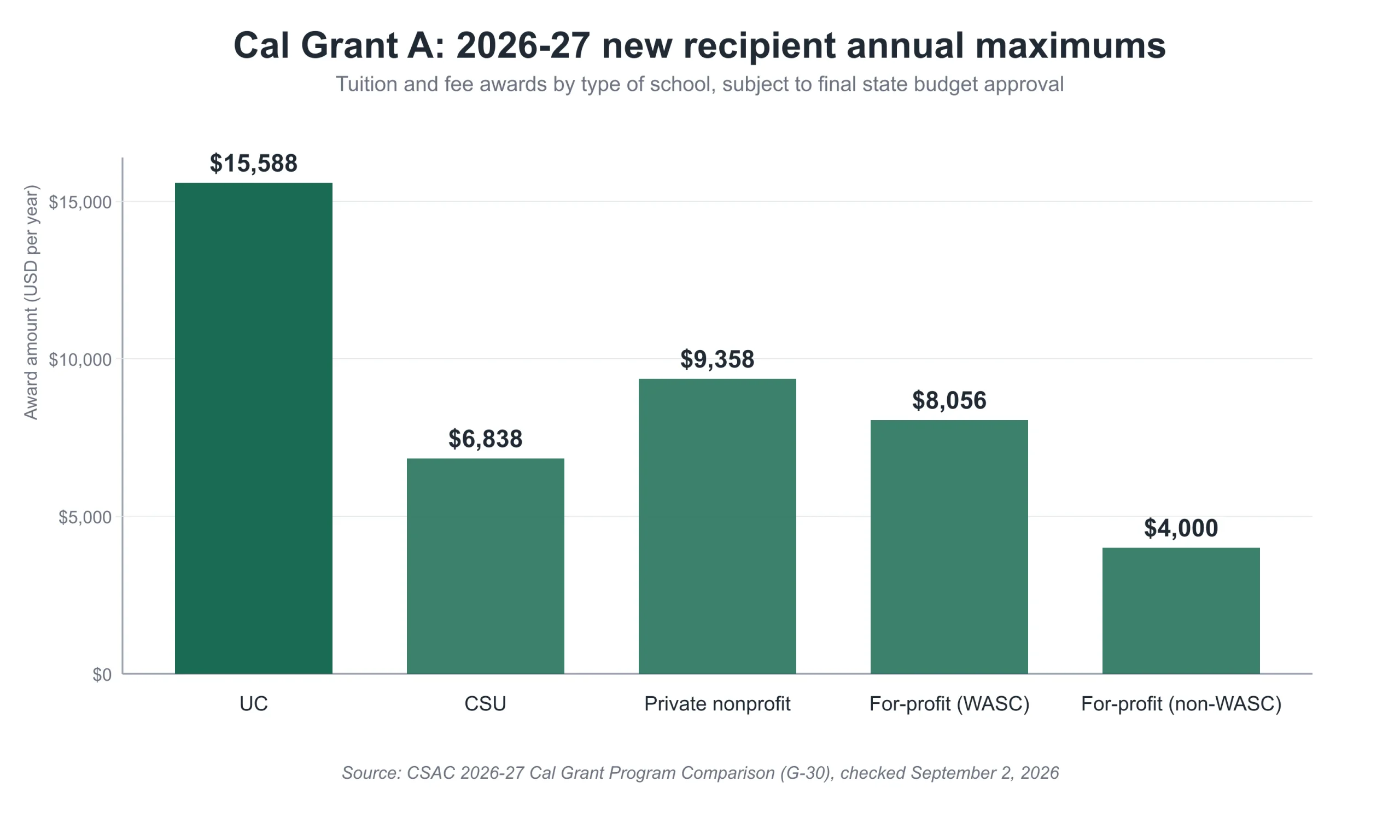
The Cal Grant is California’s main state financial aid program for college and career training, run by the California Student Aid Commission (CSAC). It doesn’t have to be repaid, and for 2026-27 it pays new recipients up to $15,588 at a UC, $6,838 at a CSU, and $9,358 at a private nonprofit, per the CSAC 2026-27 program comparison (checked September 2, 2026). Applying is free. You file the FAFSA or the California Dream Act Application, your school or college sends a verified GPA to CSAC, and CSAC decides which award you get.
The honest gate, before anything else. Cal Grant has income and asset ceilings, GPA minimums, and residency rules, so some readers won’t qualify, and CSAC makes every award decision. Nobody legitimate charges a fee to apply or to “improve” your chances. An offer like that belongs in our scam safety center, not in your budget.
A Cal Grant is state-funded gift aid for California students, awarded by CSAC in three types. Cal Grant A covers tuition and fees, Cal Grant B adds a living allowance for lower-income students, and Cal Grant C funds occupational and technical training, per csac.ca.gov (checked September 2, 2026).
Searching for business funding instead of student aid? The free Funding Eligibility Assessment takes your numbers and shows which funding lane fits.
Grants.com is a private funding-discovery and assistance platform. It is not a government agency and does not issue or approve grants unless explicitly stated for a specific programme. Grants.com does not guarantee eligibility, approval, funding, award amounts, application outcomes, loan approval, or tax-credit acceptance. Final decisions are made by independent funders, agencies, lenders, or tax authorities. Information provided through Grants.com is for general informational and educational purposes and may not reflect the most recent programme rules. Users should verify eligibility, deadlines, requirements, and application procedures with the official funding organisation.
What is the Cal Grant?
It’s a need-based grant program for California residents (and students exempt from nonresident tuition under the California Dream Act) attending an eligible California college, university, or career program. The general gates, from the CSAC 2026-27 comparison document: no prior bachelor’s degree, enrollment at least half time, satisfactory academic progress, no default on a federal or state education loan, and financial need within the published income and asset ceilings.
You don’t pick your award type. CSAC reads your FAFSA or CADAA data, your verified GPA, and your listed school, then offers the grant that pays the most for your situation.
How much is a Cal Grant in 2026-27?
New recipient annual maximums for Cal Grant A, per the CSAC 2026-27 comparison (checked September 2, 2026, subject to approval of the final state budget): $15,588 at a UC, $6,838 at a CSU, $9,358 at a private nonprofit, $8,056 at a WASC-accredited for-profit, and $4,000 at a non-WASC for-profit.
Cal Grant B works on a different clock. In your first academic year you receive only the access award of $1,648, a living allowance for books, transportation, and other costs. From the second year on, you receive the access award plus a tuition and fee award equal to Cal Grant A. The top 2 percent of new high school entitlement recipients get both parts in year one.
Cal Grant C pays $1,094 at a California Community College, or $2,462 for tuition and fees plus $547 for books and supplies at other schools.
Two add-ons raise those numbers. Students with dependent children under 18 can receive an access award of up to $6,000 on Cal Grant A or B, and up to $4,000 on C. The Foster Youth Access Award pays the same amounts for current and former foster youth no older than 25 at the start of the academic year.
One mechanic surprises community college students. At a CCC, a Cal Grant A pays $0 while you’re there; the award sits in reserve for up to two academic years until you transfer to a school that charges the tuition it covers.
What GPA do you need for a Cal Grant?
Cal Grant A requires at least a 3.0 high school GPA or a 2.4 college GPA. Cal Grant B requires at least a 2.0. Cal Grant C has no GPA requirement at all; eligibility rests on financial need and the income and asset ceilings, per the CSAC comparison document.
The GPA must be verified, and that step trips more applicants than the math. High schools and most colleges submit GPAs to CSAC electronically, but if you graduated a while ago, were homeschooled, or changed schools, confirm your GPA actually arrived. You can check it in your WebGrants for Students account, and a test score can stand in for a GPA in some cases.
Cal Grant deadlines for 2026-27
Two dates matter, per the CSAC comparison document (checked September 2, 2026).
March 2, 2026 was the deadline for the high school entitlement award, the community college transfer entitlement, and the competitive awards. September 2, 2026 is the deadline for the community college entitlement award, for Cal Grant C, and for foster youth applicants at a CCC.
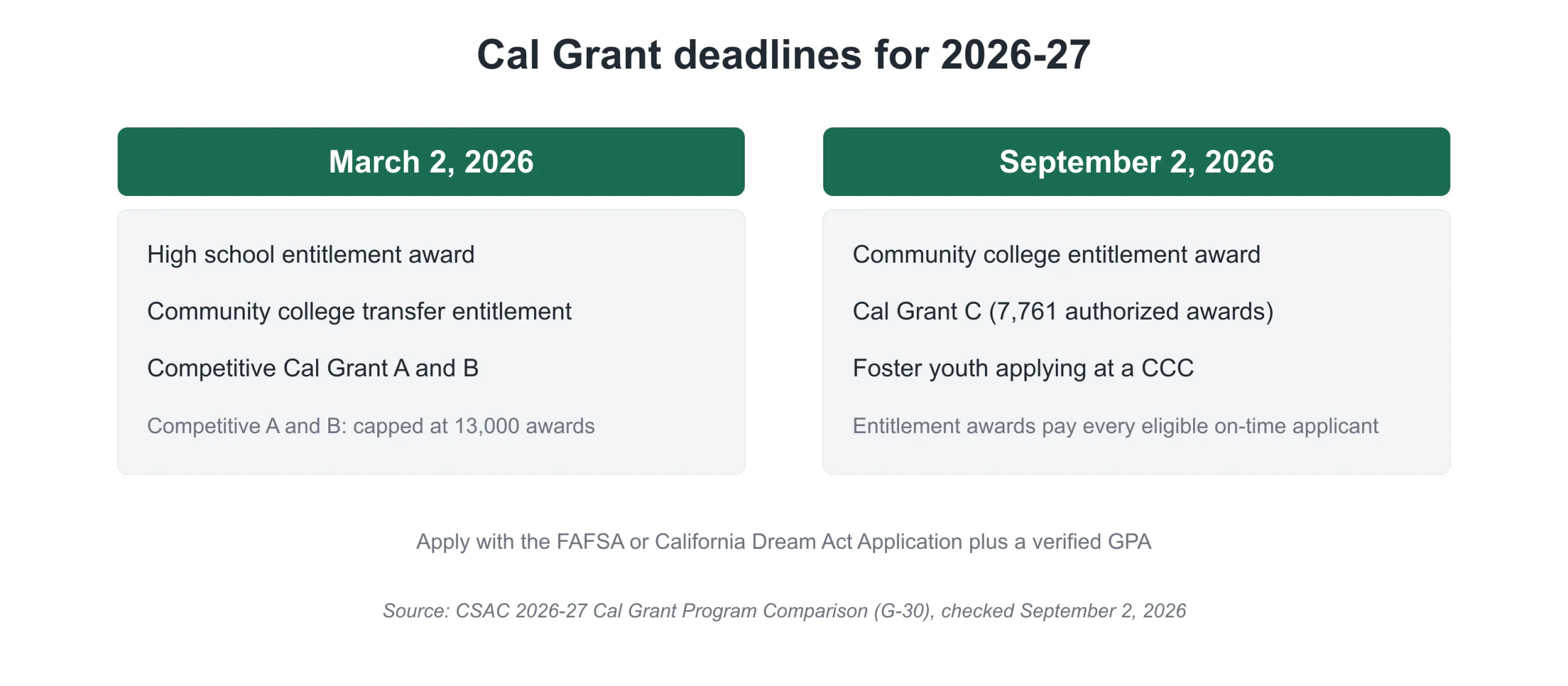
Entitlement awards go to every eligible student who applies on time. The competitive pool is capped at 13,000 awards a year, and Cal Grant C at 7,761, so students outside the entitlement paths are scored against each other on need, GPA, family circumstances, and barriers to access. Missing a deadline usually means waiting a full cycle, and missing California’s date doesn’t touch your federal aid, so file the FAFSA regardless.

How do you apply for a Cal Grant?
- File the FAFSA form, or the California Dream Act Application if you’re an undocumented or AB 540 student. Either one is free.
- Make sure a verified GPA reaches CSAC by the deadline. Ask your school whether it submits electronically; arrange it yourself if not.
- List at least one eligible California school on your application.
- Create a WebGrants for Students account to track your status, confirm your school, and complete any supplement CSAC asks for, like the Cal Grant C form.
- Renew every year: refile the FAFSA or CADAA, stay within the ceilings, and keep satisfactory academic progress.
If your award shows as pending while classes start, ask your financial aid office whether it can hold your account so you aren’t dropped from classes or charged late fees while CSAC processing finishes. And if you’re denied or disqualified and the reason doesn’t make sense, call your financial aid office first; they can work with CSAC on your behalf.
Do you have to pay back a Cal Grant?
No, it’s gift aid. The standing obligations are enrollment at least half time, satisfactory academic progress, and staying within the program’s need criteria at renewal. A Cal Grant also interacts with your other aid: your need is calculated from your school’s cost of attendance minus your other awards, so a large Pell Grant or institutional grant changes the arithmetic. Verified California and federal opportunities are searchable in the Grants Database, and the federal side of student aid is covered in our guide to grants for college. The rest of the state’s programs, including the Middle Class Scholarship and the Chafee Grant for foster youth, sit on our California grants page.
That’s the Cal Grant in full: three award types, published dollar maximums, two hard deadlines, and a free application. Check the current ceilings and amounts on csac.ca.gov before you count on a number, and if what you actually need is business funding rather than student aid, the free Funding Eligibility Assessment is the faster first step.
FAQ
What is a Cal Grant?
A Cal Grant is California’s state-funded, need-based grant for college and career training, administered by the California Student Aid Commission. It doesn’t have to be repaid, and it comes in three types: A for tuition and fees, B for lower-income students with a living allowance, and C for occupational and technical programs.
How much money is a Cal Grant?
For 2026-27, new Cal Grant A recipients receive up to $15,588 at a UC, $6,838 at a CSU, and $9,358 at a private nonprofit, per CSAC’s program comparison (checked September 2, 2026). Cal Grant B starts with a $1,648 access award in year one. Amounts depend on your school and the final state budget.
What GPA do you need for a Cal Grant?
A 3.0 high school GPA or 2.4 college GPA for Cal Grant A, a 2.0 for Cal Grant B, and no GPA at all for Cal Grant C, per csac.ca.gov (checked September 2, 2026). The GPA has to be verified with CSAC, not just earned.
What’s the difference between Cal Grant A and B?
A pays tuition and fees only. B serves lower-income students: an access award of $1,648 in the first year, then the access award plus tuition and fees equal to Cal Grant A afterward. You get whichever pays more for your program; CSAC decides.
Can I get a Cal Grant at a community college?
Yes. The community college entitlement award has its own September 2 deadline, Cal Grant B and C pay at CCCs, and a Cal Grant A is held in reserve for up to two years until you transfer to a tuition-charging school.
Is the Cal Grant the same as the Pell Grant?
No. Pell is federal, awarded through the FAFSA by the U.S. Department of Education; the Cal Grant is state aid awarded by CSAC. You can receive both, and your Cal Grant need calculation accounts for the other aid you receive.