8 min read
 24.09.2026
Pell Grant Eligibility: Who Qualifies in 2026-27
By Grants.com Editorial Team. Reviewed by Elise Perez, Grant Writer and Editorial Reviewer

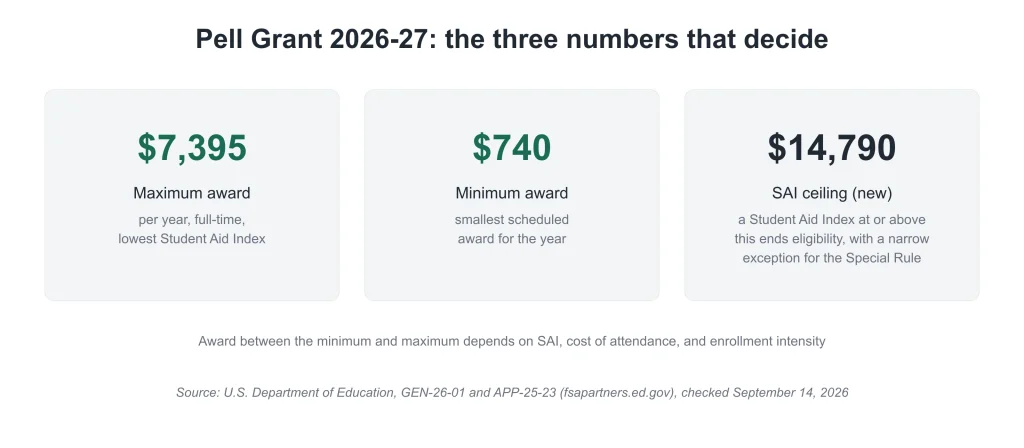
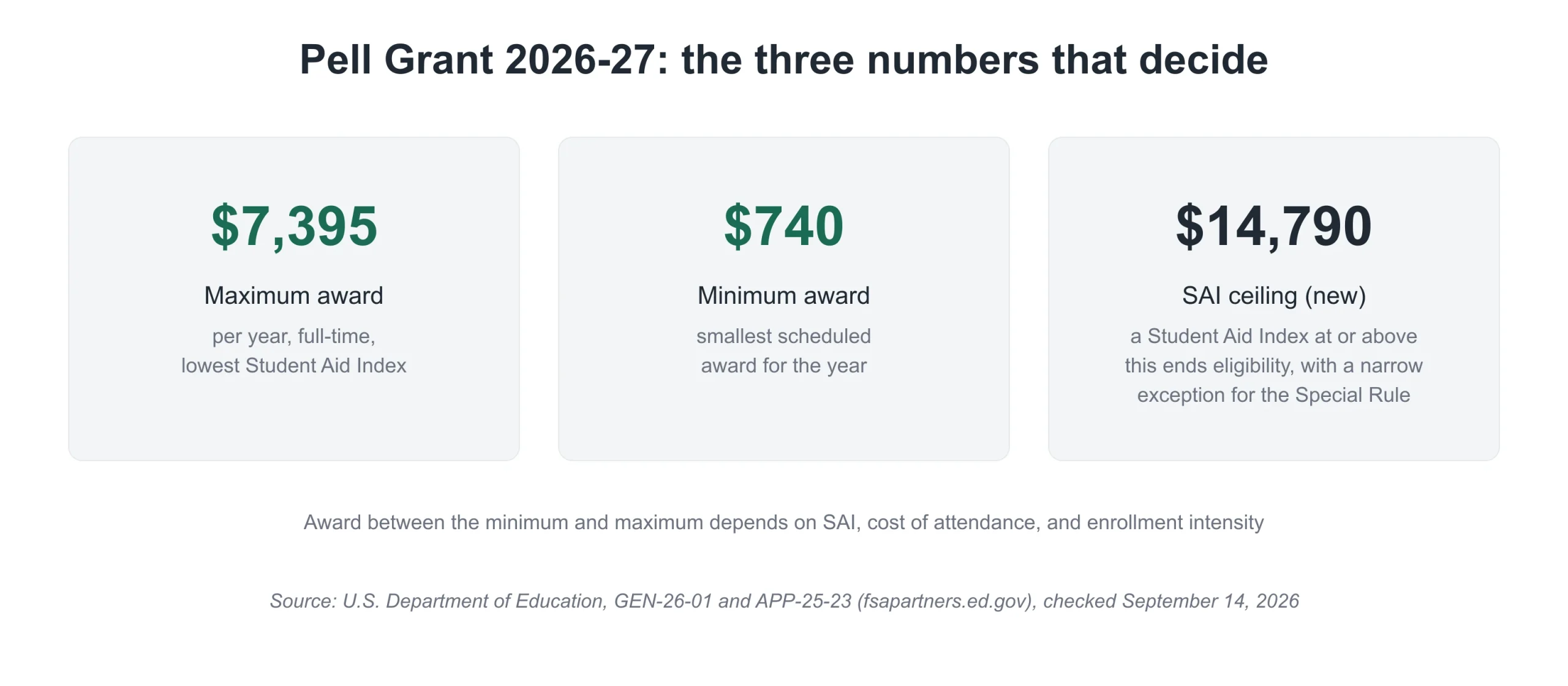
Pell Grant eligibility comes down to financial need, not grades and not a competition. Undergraduates who haven’t earned a bachelor’s degree, file the FAFSA, and show enough need under the Student Aid Index receive it, per studentaid.gov (checked September 14, 2026). For 2026-27 the award runs from $740 to $7,395, and a new rule makes students with an SAI of $14,790 or higher ineligible.
Two facts frame everything else. Applying is free through the FAFSA, and Pell isn’t competitive: every eligible student who files gets the amount they qualify for. Anyone charging a fee to “check your eligibility” or “release” a Pell Grant is running the pattern our scam safety center documents.
To be eligible for a Pell Grant, a student must be an undergraduate without a prior bachelor’s degree, demonstrate financial need through the FAFSA, be a U.S. citizen or eligible noncitizen, and maintain satisfactory academic progress, per studentaid.gov (checked September 14, 2026). The school determines the final amount.
Looking for business funding instead of student aid? The free Funding Eligibility Assessment takes your numbers and shows which lane fits.
Grants.com is a private funding-discovery and assistance platform. It is not a government agency and does not issue or approve grants unless explicitly stated for a specific programme. Grants.com does not guarantee eligibility, approval, funding, award amounts, application outcomes, loan approval, or tax-credit acceptance. Final decisions are made by independent funders, agencies, lenders, or tax authorities. Information provided through Grants.com is for general informational and educational purposes and may not reflect the most recent programme rules. Users should verify eligibility, deadlines, requirements, and application procedures with the official funding organisation.
What are the basic Pell Grant requirements?
The gates, per studentaid.gov (checked September 14, 2026): you’re an undergraduate who hasn’t earned a bachelor’s, graduate, or professional degree; you’re enrolled at a school that participates in the program; you demonstrate exceptional financial need through the FAFSA; and you keep satisfactory academic progress once you’re in. Limited exceptions cover certain postbaccalaureate teacher certification programs and eligible workforce programs.
Citizenship rules apply too: U.S. citizen or eligible noncitizen, with a valid Social Security number in most cases. And you can’t be in default on a federal student loan or owe a federal grant refund.
How is financial need measured?
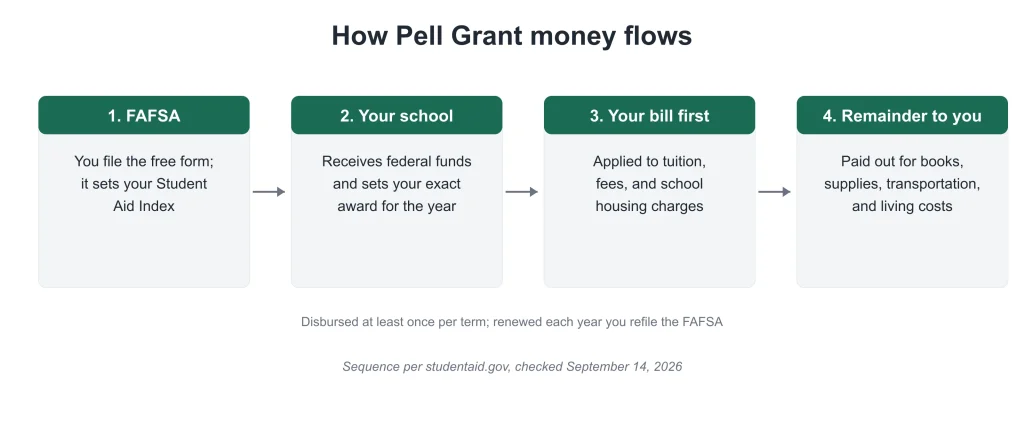
The FAFSA turns your family’s income, size, and assets into a Student Aid Index. The lower the SAI, the more Pell you’re scheduled to receive. Your school then sets the actual award using your SAI, its cost of attendance, and your enrollment intensity: full-time gets the full scheduled amount, and part-time gets a prorated share.
There’s no single income cutoff, and that surprises people. A family’s size, tax filing status, and the federal poverty guidelines all feed the calculation, so two families with the same income can get different answers. File the FAFSA and let the formula decide rather than assuming you’re over the line.
What changed for 2026-27?
Three rules are new this cycle, from the One Big Beautiful Bill Act, per the Department of Education’s 2026-27 eligibility update (checked September 14, 2026).
First, a hard ceiling: an SAI of $14,790 or higher, which is twice the maximum award, makes a student ineligible for Pell. The one exception is the Special Rule for dependents of certain deceased servicemembers and public safety officers.
Second, foreign earned income that was excluded from taxes now gets added back to adjusted gross income when Pell eligibility is determined.
Third, some assets left the FAFSA math entirely. The net worth of a family-owned business with 100 or fewer full-time employees, a family farm the family lives on, and a family commercial fishing business no longer count. Families who skipped the FAFSA in past years because of a business or farm on the books have a reason to file again.
Does GPA affect Pell Grant eligibility?
Not for getting it. Pell eligibility is about money, not merit; there’s no GPA screen on the way in. Grades enter the picture only after you enroll, through your school’s satisfactory academic progress standard, and falling below that standard can pause any federal aid, Pell included. Keep passing and progressing toward your degree and the grant renews with your yearly FAFSA.
One related catch from the fine print: aid applies to your degree program. A class outside your degree plan may not be covered, so confirm with your financial aid office before registering for extras.
How much is the Pell Grant in 2026-27?
The maximum award is $7,395 and the minimum is $740 for the 2026-27 award year, per the Department of Education’s award amounts letter (checked September 14, 2026). Where you land between them depends on your SAI, your school’s cost of attendance, and whether you’re full-time or part-time.
Two multipliers matter over your college career. Year-round Pell lets an eligible student receive up to 150 percent of a scheduled award in one year by attending an additional term, like summer. And the lifetime limit caps everyone at the equivalent of 12 full-time terms, roughly six years; you can track your remaining share on StudentAid.gov.
How do you apply?
- Create a StudentAid.gov account for yourself and any required parent or contributor.
- File the FAFSA form as early as you can for your award year. It’s free.
- Read your FAFSA Submission Summary for your SAI and estimated eligibility.
- Let each school you listed package the exact award after admission.
- Refile every year. Eligibility is redetermined annually, so a change in family income, size, or the rules themselves can move your award in either direction.
That’s Pell Grant eligibility in full: need measured by the FAFSA, no GPA gate, a $14,790 SAI ceiling new this year, and awards from $740 to $7,395. What a Pell Grant is and how the money actually reaches you is covered in our companion guide to what a Pell Grant is, the wider federal picture lives in our guide to grants for college, and if you’re actually seeking business funding, the free Funding Eligibility Assessment is the faster first step.
FAQ
What income qualifies for a Pell Grant?
There’s no single cutoff. The FAFSA turns income, family size, tax filing status, and the federal poverty guidelines into a Student Aid Index, and the SAI decides. For 2026-27, an SAI of $14,790 or higher makes a student ineligible, per fsapartners.ed.gov (checked September 14, 2026).
Does GPA affect Pell Grant eligibility?
No GPA is required to receive a Pell Grant. Grades only matter after enrollment, through your school’s satisfactory academic progress standard, which all federal aid requires you to maintain.
Can you get a Pell Grant part-time?
Yes. Part-time students receive a prorated share of their scheduled award based on enrollment intensity. Full-time enrollment receives the full scheduled amount.
Do you have to reapply for the Pell Grant every year?
Yes. Eligibility is redetermined each award year from a new FAFSA, so changes in income, family size, or federal rules can raise or lower your award.
Can graduate students get a Pell Grant?
Generally no. Pell is for undergraduates without a bachelor’s degree, with limited exceptions for certain postbaccalaureate teacher certification programs, per studentaid.gov (checked September 14, 2026).
Is the Pell Grant first come, first served?
No. Every eligible student receives the full amount they qualify for; participating schools are funded for all eligible students. Filing early still matters for state and campus-based aid, which can run out.