14 min read
 19.08.2026
Do SBA Grants Exist? What’s Real and What Isn’t
By Grants.com Editorial Team. Reviewed by Elise Perez, Grant Writer and Editorial Reviewer

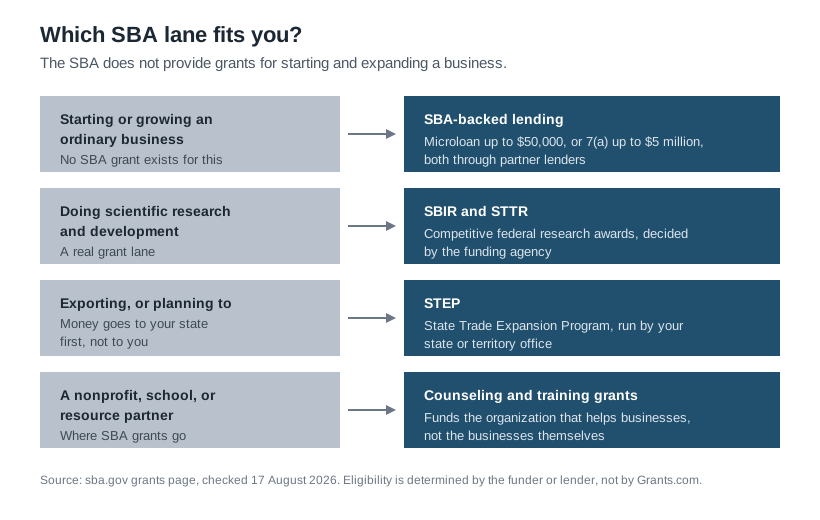
SBA grants exist, but almost certainly not for you. The SBA’s own grants page states it plainly (checked August 17, 2026): “SBA does not provide grants for starting and expanding a business.” The grants the SBA does award go to nonprofits, Resource Partners, and educational organizations that teach and counsel entrepreneurs, plus a few narrow lanes covered below.
We run a site called Grants.com, and we’re telling you this above the fold because the sites that won’t are selling you something.
The SBA does not give grants to start or grow an ordinary business, per sba.gov (checked August 17, 2026). Its grants fund nonprofits, entrepreneurship counseling, scientific research programs, and state export programs. For most for-profit owners searching “SBA grants,” the realistic path is an SBA-backed loan.
Want the honest answer for your own business? Take the free Funding Eligibility Assessment and see which lane your numbers fit.
Grants.com is a private funding-discovery and assistance platform. It is not a government agency and does not issue or approve grants unless explicitly stated for a specific programme. Grants.com does not guarantee eligibility, approval, funding, award amounts, application outcomes, loan approval, or tax-credit acceptance. Final decisions are made by independent funders, agencies, lenders, or tax authorities. Information provided through Grants.com is for general informational and educational purposes and may not reflect the most recent programme rules. Users should verify eligibility, deadlines, requirements, and application procedures with the official funding organisation.
Does the SBA give grants to small businesses?
Not for starting or expanding one. That’s the SBA’s published position, word for word, on its grants page. What the agency funds instead is the support system around small business: organizations that provide counseling and training, veteran entrepreneurship programs, and Small Business Development Centers.
The distinction matters because an entire industry profits from blurring it. When a site or a caller promises SBA grant money to launch your business, they’re describing a program the agency itself says doesn’t exist.
The SBA grant programs that actually exist
Three narrow lanes are real, and each has a specific gate. None of them is general-purpose business funding.
Research and development. Small businesses doing scientific R&D may qualify for federal awards under the SBIR and STTR programs, which fund research meeting federal R&D objectives. This lane is real and it’s not small. The sbir.gov award database listed 219,517 awards on August 17, 2026, covering every year since 1983: 197,644 under SBIR and 21,873 under STTR.
Two numbers in that database describe the gate better than any adjective. Phase I awards total 151,430. Phase II awards total 68,087. Those counts span four decades and aren’t a single cohort, so they don’t give you a conversion rate. What they show is the shape: getting a first award is a different event from getting the second, and the first outnumbers the second by more than two to one.
If your business doesn’t run research projects, this lane isn’t yours. Eligibility is the funding agency’s determination, never anyone’s promise.
Exporting. The State Trade Expansion Program (STEP) sends financial awards to state and territory governments, not directly to businesses. Your state’s program office then helps established small businesses with export costs like trade missions and translation. If you’re not exporting, it doesn’t apply.
Community organizations. The counseling and training grants go to nonprofits and Resource Partners. Your business benefits from these as free or low-cost help, not as money in your account.
Who actually qualifies for the money people search for?
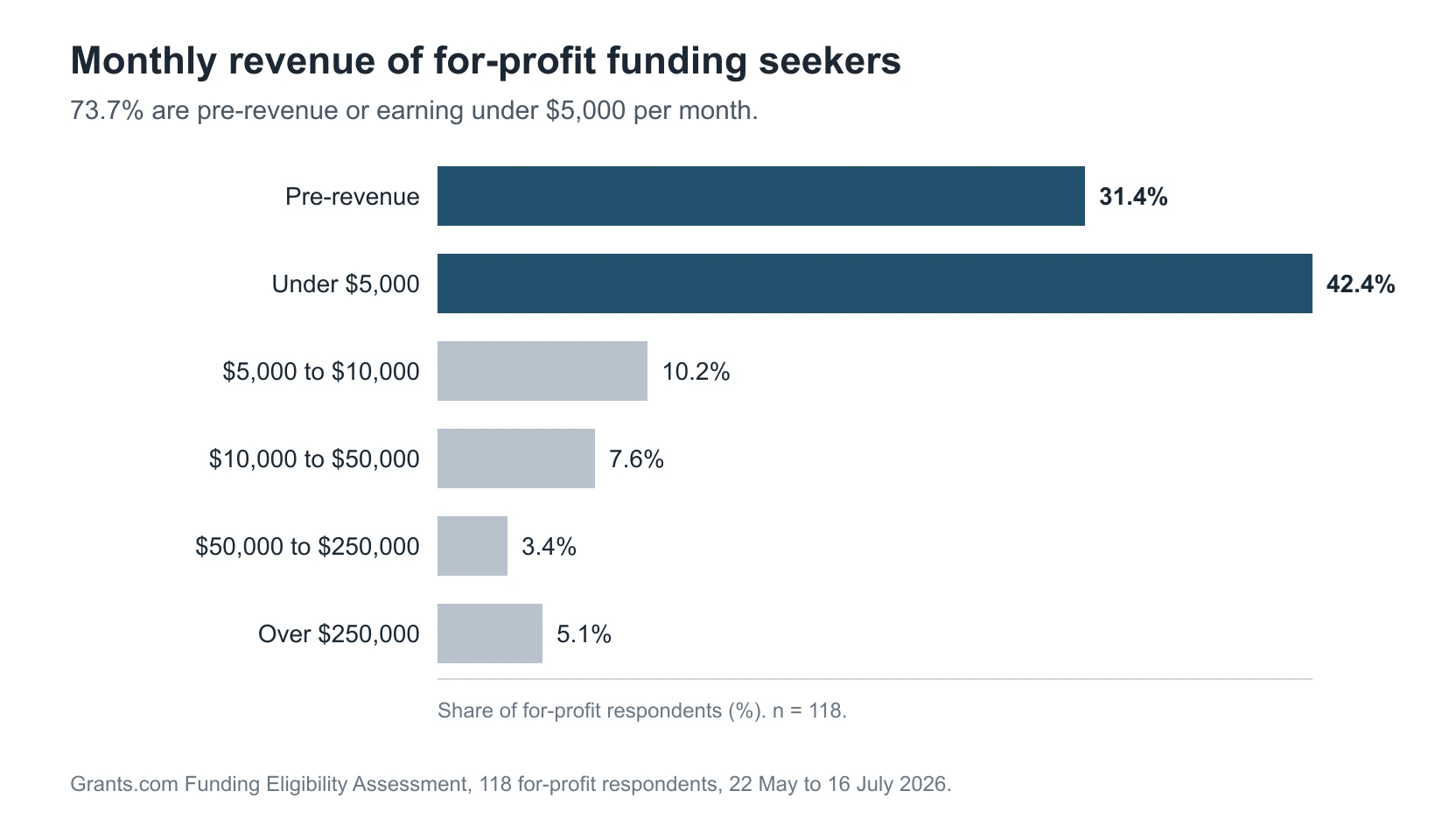
Mostly, nobody in the searching crowd, and our own data shows why. Among 118 for-profit respondents to the Grants.com Funding Eligibility Assessment between 22 May and 16 July 2026, 73.7% were pre-revenue or earning under $5,000 per month, and 51.7% had operated for one year or less. (Source: Grants.com Funding Eligibility Assessment, 118 for-profit respondents, 22 May – 16 July 2026.)
Grant funders, where for-profit grants exist at all, run competitive processes that favor documentation, track record, and a defined project. A business that’s four months old with no revenue rarely wins those competitions. It’s not a character judgment. It’s how award decisions work.
So the honest reading of a search for “SBA grants” is usually a funding need wearing grant vocabulary. Non-repayable funding is the exception; debt financing built for small operators is the standing system.
The real lane for most businesses
The SBA’s actual offer to for-profit businesses is lending through partners. Two programs cover most cases. For amounts up to $5 million, the 7(a) program works through banks and other partner lenders; the published gate is on our SBA loan requirements page. For amounts under $50,000, which matches what 44.5% of our assessment respondents were seeking, SBA microloans run through nonprofit community lenders, per sba.gov.
Both are loans. They repay. A loan you can get beats a grant that doesn’t exist.
Why people still call EIDL and PPP grants
Because the money arrived during an emergency and the labels blurred. Both were lending programs. The SBA’s COVID-era programs page describes COVID-19 EIDL as having “provided loans and advances,” and calls the Paycheck Protection Program “this SBA loan program” (checked August 17, 2026).
That memory still shapes what people search for. Someone who watched a neighbour receive pandemic money that behaved like a grant reasonably assumes a standing program exists. It doesn’t, and the programs that delivered that money have ended.
The practical effect is that scam offers borrow the emergency framing. Disaster and relief language does real work for a fraudster, because it explains why you’d be getting money you never applied for.
What is the $10,000 SBA grant?
There’s no standing $10,000 SBA grant for starting or growing a business. The SBA’s grants page, checked August 17, 2026, lists no such program, and the agency’s blanket statement quoted above rules it out. Offers built around a specific dollar figure circulate on social media and by phone, and they run against the plainest rule the FTC publishes: the government won’t get in touch out of the blue about grants.
If you saw the number somewhere, treat it as a flag to verify at the source. The only reliable inventory of SBA grant activity is sba.gov itself.
How to spot an SBA grant scam
Four checks, all from federal sources, settle nearly every case.
Any upfront payment ends the conversation. Applying for a federal grant is free, and the FTC’s guidance on government grant scams (updated July 15, 2026) goes further: don’t pay for a list of grants either, because the only list is at grants.gov and it’s free. The SBA Inspector General’s office states the same rule from the lending side, warning that anyone promising to get an SBA loan approved while requiring payment up front is a fraud signal, and that SBA representatives never charge applicants for assistance, inspections, or help filling out an application. The fee has many names: processing, release, application, taxes, customs. The name doesn’t matter. The request itself is the answer.
Check the email domain, not the logo. The SBA only communicates from addresses ending in @sba.gov, stated on both its grants page and its Inspector General’s scam page. And the Inspector General adds a warning worth reading twice: the presence of an SBA logo on a webpage does not mean the information is accurate or endorsed by the SBA. A convincing seal costs a scammer nothing.
Invented agencies sound real on purpose. The FTC’s example is “the Federal Grants Administration, which doesn’t exist.” Anyone can invent a plausible bureau name, and the check is not whether it sounds official but whether you can find it on a .gov site.
Payment method is a giveaway. Gift cards, cash reload cards, wire transfers, and cryptocurrency are always a scam when a supposed agency asks for them, per the FTC. A promised refund if you’re unsatisfied is part of the script, not a safeguard.
Two patterns deserve their own line because they’re built to bypass the checks above. Disaster and relief offers exploit real distress, and the Inspector General addresses them directly: federal and local disaster workers don’t solicit or accept money, and nobody should be promising a disaster grant in return for payment. Separately, an approach arriving through a social-media message is not verified by the account it came from. That’s an observation rather than a published finding, but the reasoning is simple: an account can be stolen, copied, or faked, and the FTC lists social-media messages among the channels these offers use.
Where to verify anything you were sent
Three places, and nowhere else. Programme facts belong to sba.gov. Federal grant opportunities and the free-application rule belong to grants.gov. Research awards belong to sbir.gov. If a claim can’t be found on one of those, the claim is the problem.
To report an attempt, the FTC takes reports at ReportFraud.ftc.gov, and the SBA Office of Inspector General runs its own hotline for fraud involving SBA programs. Our scam safety center covers the wider pattern list, and the Grants Database is where to look if you want to see what real, applied-for opportunities look like.
One more step before you apply for anything. The free Funding Eligibility Assessment takes your actual numbers, time in operation, revenue, amount sought, and shows whether the grant lane, the loan lane, or counseling fits. Individual outcomes vary and every funder decides for itself, but you’ll stop spending weeks on programs that were never built for you.
That’s the full picture on SBA grants: real for nonprofits, researchers, and exporters, and not a startup fund for everyone else, no matter how many ads say otherwise.
FAQ
Are SBA grants real?
Yes, in narrow lanes. The SBA awards grants to nonprofits, Resource Partners, and educational organizations, and runs R&D (SBIR/STTR) and state export (STEP) programs, per sba.gov (checked August 17, 2026). What’s not real is an SBA grant for starting or expanding an ordinary business; the SBA states it does not provide those.
How do I apply for an SBA grant?
If your business does scientific R&D, apply through the SBIR/STTR process; if you export, contact your state’s STEP office. Applying for any federal grant is free and always runs through a government website, per grants.gov. If neither lane fits your business, there’s no SBA grant application for you to file, and that’s worth knowing before you pay anyone for help.
Do you have to pay back an SBA grant?
A real grant isn’t repaid, but it isn’t free of obligations either: eligibility rules, allowable costs, and reporting requirements all apply. SBA loans, the far more common path for for-profit businesses, do repay. Anything marketed as an SBA “grant” that behaves like a loan, or asks for a fee, deserves scrutiny.
Does the SBA give out $10,000 grants?
No standing program does this. The SBA’s grants page (checked August 17, 2026) lists no $10,000 grant for starting or growing a business, and states the SBA does not provide grants for that purpose. Specific-dollar offers arriving by phone, text, or social media run against the FTC’s rule that the government won’t contact you out of the blue about grants.
Is there an SBA disaster relief grant?
SBA disaster assistance for businesses runs as loans, and the SBA Office of Inspector General warns that federal and local disaster workers don’t solicit or accept money and that nobody should promise a disaster grant in return for payment. If a “disaster grant” offer asks you to pay anything, that request is the answer.
How many SBIR and STTR awards are there?
The sbir.gov award database listed 219,517 awards on August 17, 2026, covering 1983 onward: 197,644 SBIR and 21,873 STTR, including 16,233 to woman-owned businesses. SBIR notes that recent-year data isn’t complete until the following March, so the most recent year always undercounts.
What can I get from the SBA instead of a grant?
Lending and free help. The 7(a) program reaches up to $5 million through partner lenders, microloans reach up to $50,000 through nonprofit intermediaries, and SBA-funded Resource Partners provide free or low-cost counseling and training, all per sba.gov. Eligibility is decided by the lender or program, and outcomes vary by business.