

SBA Loan Requirements and Who Qualifies
SBA Loan Requirements and Who Qualifies
SBA lending
What the SBA actually publishes, what the lender decides, and who will not qualify.

The SBA loan requirements for the main 7(a) program are shorter than most sites make them look. According to sba.gov (checked August 17, 2026), a business must be operating, for profit, located in the U.S., small under SBA size standards, creditworthy with a reasonable ability to repay, and unable to get the same credit on reasonable terms elsewhere. That’s the whole published list.
What’s not on it matters just as much. No minimum credit score. No revenue floor. No required years in business. The SBA guarantees part of the loan; a partner lender makes the actual credit decision, and each lender sets its own bar.
To be eligible for an SBA 7(a) loan, a business must operate for profit in the U.S., meet SBA size standards, be creditworthy, and be unable to obtain reasonable credit elsewhere, per sba.gov (checked August 17, 2026). The SBA publishes no universal minimum credit score. The partner lender makes the credit decision.
Not sure this is your lane? The free Funding Eligibility Assessment shows which funding type fits your business before you spend weeks on an application.
Grants.com is a private funding-discovery and assistance platform. It is not a government agency and does not issue or approve grants unless explicitly stated for a specific programme. Grants.com does not guarantee eligibility, approval, funding, award amounts, application outcomes, loan approval, or tax-credit acceptance. Final decisions are made by independent funders, agencies, lenders, or tax authorities. Information provided through Grants.com is for general informational and educational purposes and may not reflect the most recent programme rules. Users should verify eligibility, deadlines, requirements, and application procedures with the official funding organisation.
What are the SBA’s 7(a) eligibility rules?
Seven conditions, all published on the 7(a) loan program page (checked August 17, 2026). Your business must:
- Be an operating business. An idea on paper doesn’t qualify; a business that has started operating may.
- Operate for profit. Nonprofits are outside the 7(a) program.
- Be located in the U.S.
- Be small under SBA size requirements. “Small” is defined industry by industry, in revenue or employee counts, under federal size standards. Many businesses that feel mid-sized still fit.
- Not be an ineligible business type. The regulation lists categories such as lenders and passive real-estate investment.
- Be unable to obtain the desired credit on reasonable terms from non-government sources. In plain terms, SBA backing exists for businesses a bank wouldn’t fund on its own standard terms.
- Be creditworthy and show a reasonable ability to repay.
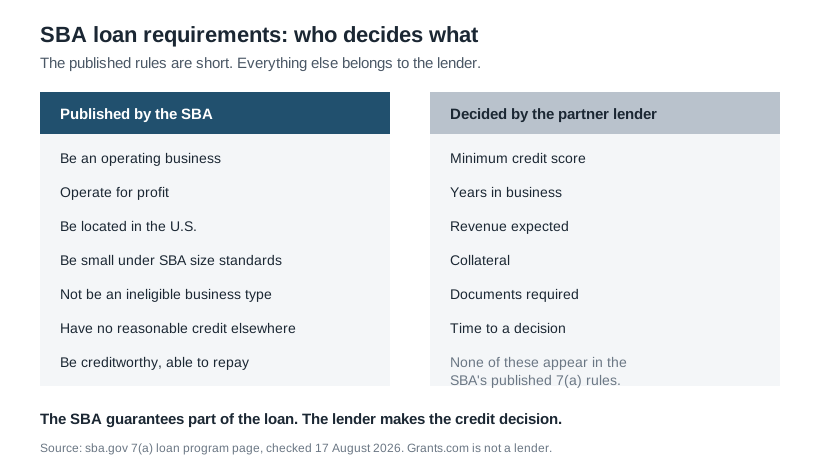
Every item is a “may be eligible” gate, not a promise. The lender and the SBA make the eligibility determination, not this page and not any platform.
Is there a minimum credit score for an SBA loan?
The SBA’s published 7(a) eligibility rules contain no minimum credit score. The requirement, as sba.gov states it, is to “be creditworthy and demonstrate a reasonable ability to repay the loan.” Each partner lender decides what creditworthy means for its own book.
You’ll find specific numbers on other sites. Those are individual lenders’ standards, or guesses, presented as SBA policy. Treat any “SBA requires a 680” claim as a sign to check the source.
The practical version: a lender will look at your credit history, cash flow, and documentation. A weaker score doesn’t disqualify you by rule. It does mean the lender’s judgment carries more weight, and different lenders will answer differently.
How much you can borrow, and what applicants actually ask for
The maximum 7(a) loan amount is $5 million, per sba.gov (checked August 17, 2026). Almost nobody needs that.
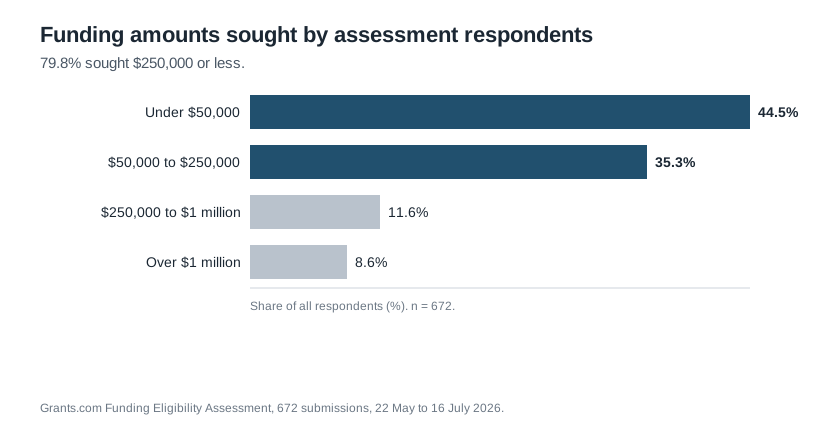
Across 672 Funding Eligibility Assessment submissions collected between 22 May and 16 July 2026, 79.8% of respondents sought $250,000 or less, and 44.5% sought under $50,000. (Source: Grants.com Funding Eligibility Assessment, 672 submissions, 22 May – 16 July 2026.)
That has a useful consequence. If you’re in the under-$50,000 group, a full 7(a) application may be more process than you need. The SBA runs a separate program for exactly that range: SBA microloans lend up to $50,000 through nonprofit intermediary lenders.
What can the money be used for? The SBA’s published list covers buying, refinancing, or improving real estate and buildings, short- and long-term working capital, refinancing current business debt, machinery and equipment, furniture, fixtures, and supplies, and ownership changes.
Grants, SBA loans, and equipment financing compared
Most people who land on a page like this started by searching for a grant. The comparison below is the honest version of that choice. For the fuller breakdown, read our guide to business grants versus loans.
| Grants | SBA 7(a) loans | Equipment financing | |
|---|---|---|---|
| What it is | Non-repayable funding for a defined purpose, awarded through a competitive process | Debt financing from a partner lender, partly backed by the SBA | A loan or lease tied to a specific piece of equipment |
| Repayment | Not repaid, but carries eligibility, allowable-cost, and reporting obligations | Repaid; most 7(a) term loans carry monthly principal and interest payments | Repaid; the equipment itself usually serves as collateral |
| Who it usually fits | Mostly nonprofits and defined project purposes; rare for ordinary for-profit operations | Operating for-profit businesses that can’t get reasonable credit elsewhere | Businesses buying a specific truck, machine, or oven |
| Who decides | The funder | The lender, under SBA rules | The lender |
How to apply through an SBA lender
You apply directly through a local lender, never through the SBA itself. Two facts from sba.gov shape the whole process (checked August 17, 2026): the contents of the application vary with the loan size and the lender’s processing method, and your lender tells you which documents you’ll need. So the realistic first step isn’t paperwork. It’s finding the lender.
The SBA’s own Lender Match tool connects you with participating lenders, and SBA District Offices give free in-person, online, or phone help with the process. Both are free. Nobody legitimate charges you to be introduced to an SBA lender.
Expect the lender to want financial statements, and be ready to explain the use of funds in the same categories the program publishes. Beyond that, document lists differ lender to lender, and pretending otherwise would be a guess.
Who won’t qualify
An honest requirements page has to say this part out loud.
You’re unlikely to qualify for a 7(a) loan if your business isn’t operating yet, if it runs as a nonprofit, if it falls into an ineligible category under 13 CFR 120.110, or if a lender concludes the cash flow can’t carry the payments. A business that can already get the same credit on reasonable terms from a bank is ineligible by rule, not despite being strong but because of it.
If that’s you, it doesn’t mean no funding exists. It means this program isn’t the lane, and finding the right lane early is cheaper than a declined application. The Grants Database covers the non-repayable side, and the microloan program covers smaller amounts through different lenders with their own standards.
Where you actually stand depends on facts about your business, and the fastest way to organize those facts is the free Funding Eligibility Assessment. It won’t approve anything. No assessment can. It shows which programs fit your numbers so the applications you do file are the right ones.
The SBA loan requirements themselves are stable and public: operating, for profit, U.S.-based, small by federal standards, creditworthy, and unable to get reasonable credit elsewhere. Everything past that list belongs to the lender, so choose the lender conversation, not the myth of a universal checklist, as your next step.
Frequently asked questions
Do startups meet SBA loan requirements?
Sometimes. The SBA requires an operating business, so a pre-launch idea doesn’t qualify, but a newly operating business may be eligible. The lender weighs credit history and repayment ability, and standards differ by lender. Per sba.gov, key eligibility factors are what the business does for income, its credit history, and where it operates.
What credit score do SBA loan requirements call for?
None by rule. The SBA’s published 7(a) eligibility list (checked August 17, 2026) requires creditworthiness and a reasonable ability to repay, with no numeric score. Each partner lender sets its own credit standards, so the same file can get different answers from different lenders.
Do you have to pay back an SBA loan?
Yes. An SBA loan is debt financing, and most 7(a) term loans are repaid in monthly payments of principal and interest from business cash flow, per sba.gov. If someone offers you an SBA “loan” that never needs repayment, you’re looking at a scam pattern, not a program.
How long does SBA loan approval take?
The SBA publishes no universal timeline for 7(a) decisions. Application contents and processing vary with the loan size and the lender’s method, so the honest answer comes from the lender you apply with. Ask them for their current timeline before you file.
Does the SBA lend money directly?
No. For 7(a) loans you always work directly with a partner lender, not with the SBA, per sba.gov. The SBA guarantees part of the loan, which is what makes lenders willing to fund businesses they’d otherwise decline.
Can you get an SBA loan to buy equipment?
Yes. The SBA’s published 7(a) uses include purchasing and installing machinery and equipment. For a purchase under $50,000, compare the microloan program, which covers machinery and equipment and works through nonprofit intermediary lenders.