5 min read
 29.01.2026
What Is a Grant? Types, Eligibility, and How to Apply (2026 Guide)

What Is a Grant? Definition, Meaning, and Examples
A grant is a form of financial assistance provided by a government, foundation, corporation, or other organization to support a specific goal or project. Unlike loans, grants do not require repayment, making them a valuable funding source for individuals, small businesses, nonprofits, and students seeking financial support.
Organizations award grants to advance objectives such as education, scientific research, community development, or business innovation. Each grant has unique rules and requirements. Recipients must use the funds as intended and often report on their progress or outcomes to the grant provider.
For example, a local government might offer a small business grant to help companies recover after a natural disaster, while a foundation could fund a nonprofit’s literacy program. To learn more about the fundamentals, see our comprehensive guide on what a grant is, its types, eligibility, and how to apply.
Types of Grants: Government, Private, Nonprofit & More
Grants come in many forms, each tailored to different needs and recipients. Common types of grants include:
– Government Grants: Provided by federal, state, or local agencies to support public projects, research, education, disaster relief, and more. For instance, the National Institutes of Health funds medical research through competitive grants.
– Private Grants: Corporations and private foundations offer these to support charitable, educational, or business initiatives. The Bill & Melinda Gates Foundation, for example, funds global health and education projects.
– Nonprofit Grants: Awarded specifically to nonprofit organizations to help them fulfill their missions, such as environmental conservation or social services.
– Educational Grants: Designed for students or educational institutions to cover tuition, research, or program costs. The Pell Grant is a well-known example for undergraduate students in the U.S.
– Research Grants: Support scientific, medical, or social research. Universities and research institutes often rely on these to advance knowledge.
– Business Grants: Help startups or existing businesses grow, innovate, or recover from setbacks. For example, the Small Business Innovation Research (SBIR) program funds technology startups.
– Individual Grants: Provide direct support for personal needs, such as emergency relief, artistic projects, or professional development. For more details on finding and applying for grants, check out our step-by-step guide.
Grants vs. Loans vs. Scholarships: Key Differences
While grants, loans, and scholarships all provide financial support, they differ in key ways:
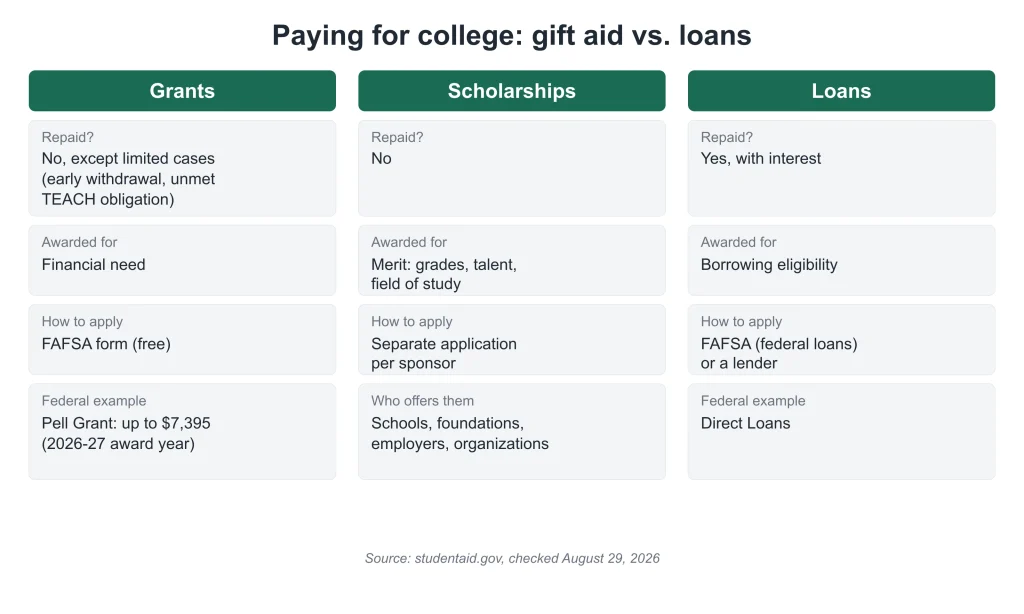
– Grants: Do not require repayment. They are usually awarded based on financial need, project goals, or community impact.
– Loans: Must be repaid with interest, regardless of how the funds are used. Student loans, for example, require repayment after graduation.
– Scholarships: Like grants, scholarships are non-repayable. However, they are typically awarded for academic achievement, athletic talent, or other specific criteria.
Choosing the right type of funding depends on your goals and circumstances. For instance, a student with high grades might pursue scholarships, while a nonprofit may seek grants for a community project. For a detailed comparison, read our guide on the key differences between grants, loans, and scholarships.
How Are Grants Funded? Sources & Funding Breakdown
Grants are financed by a range of sources, including government agencies, private foundations, corporations, and nonprofit organizations. Government grants often use taxpayer dollars, while private and nonprofit grants rely on donations, endowments, or corporate profits.
Each funder sets its own priorities and guidelines. For example, a corporation might focus on STEM education, while a community foundation supports local arts programs. Understanding a funder’s mission can help applicants tailor their proposals and increase their chances of winning grant funding.
Grant Eligibility Criteria: Who Qualifies for Grants?
Eligibility requirements vary widely depending on the grant’s purpose and the funder. Common grant eligibility criteria include:
– Type of applicant (such as individual, business, nonprofit, or educational institution)
– Geographic location or community served
– Project or program focus (for example, health, education, or technology)
– Financial need or organizational capacity
Some grants have very specific requirements, such as serving a particular demographic or addressing a targeted issue. Always review eligibility details carefully before applying. For more information, see our guide on grant eligibility criteria.
How to Apply for Grants: Step-by-Step Application Process
Applying for a grant involves several key steps. Follow this grant application process to improve your chances of success:
1. Research available grants and identify those that match your needs and qualifications.
2. Review eligibility criteria and application guidelines to ensure you meet all requirements.
3. Prepare required documents, such as a detailed proposal, budget, and letters of support.
4. Submit your application before the deadline, following all instructions carefully.
5. Wait for the review and selection process, which may include interviews or additional documentation.
6. If awarded, comply with reporting and monitoring requirements to demonstrate proper use of funds.
A well-prepared grant application increases your chances of winning funding. For a detailed walkthrough, check out our step-by-step grant process guide.
Grant FAQs: Common Questions About Grants Answered
Q: What is a grant?
A: A grant is non-repayable funding provided for a specific purpose or project.
Q: How do grants work?
A: Grants are awarded based on eligibility and application review. Recipients must use funds as specified and may need to report on outcomes.
Q: Who can apply for grants?
A: Eligibility depends on the grant, but individuals, businesses, nonprofits, and educational institutions can all be eligible.
Q: What are the main types of grants?
A: Government, private, nonprofit, educational, research, business, and individual grants.
Q: How are grants different from loans?
A: Grants do not need to be repaid; loans do.
Q: How do I find grants I am eligible for?
A: Start by researching grant databases, government websites, and our guides to find grants that match your profile. For more tips, see our complete guide on how to find and apply for grants.
About Grants
Find grants with our guides.
Visit https://grant.com to start.